
For small business owners in the Oceanside region, time is money – it’s the single most precious resource. You are already juggling inventory, customer service, marketing, accounting, and everything in between. If you have experimented with standard AI tools or basic chatbots over the last couple of years, you might have found them helpful for brainstorming an email or writing a product description, but ultimately useless for actually completing a multi-step, complex project.
Enter Agentic AI.
Agentic AI is a massive leap forward. It is not just a reactive chatbot that waits for you to ask it a question; it is a system of autonomous digital workers that can perceive a goal, plan a series of steps, interact with other software, and execute complex business tasks from start to finish without your constant supervision. By transitioning from simple AI assistants to proactive, multi-agent systems, local businesses can achieve enterprise-level efficiency on a startup budget. For small business Oceanside entrepreneurs looking into AI automation, understanding how these autonomous agents work together is a critical step toward reclaiming your time, scaling your operations, and even outmaneuvering larger competitors.
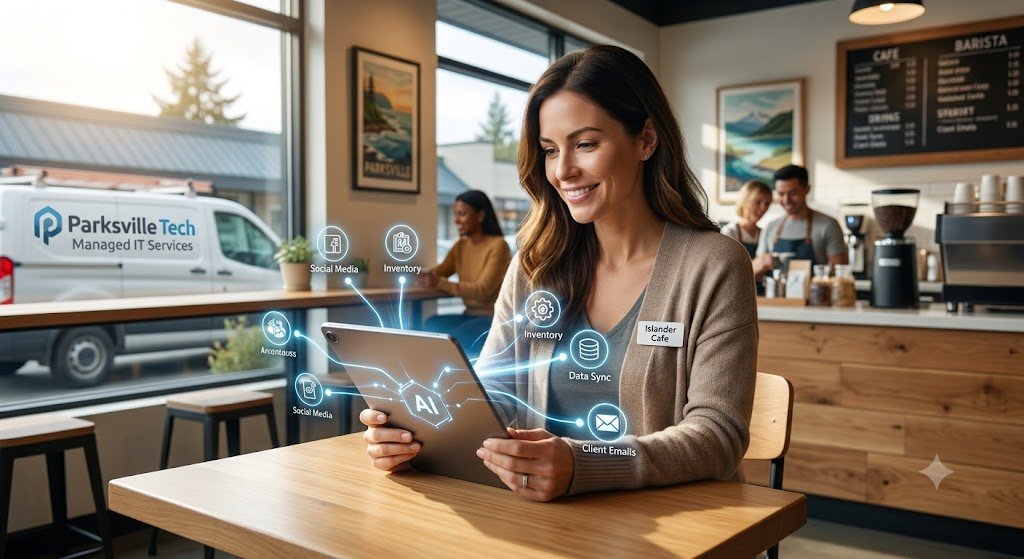
Beyond the Basic Chatbot: What is a Multi-Agent System?
When we talk about Agentic AI, we are usually talking about “Multi-Agent Systems.” But why do we need multiple agents? Since the underlying intelligence (like a large language model such as Gemini) is doing the heavy lifting, splitting it up into different “agents” can sound a bit like giving the software a multiple personality disorder.
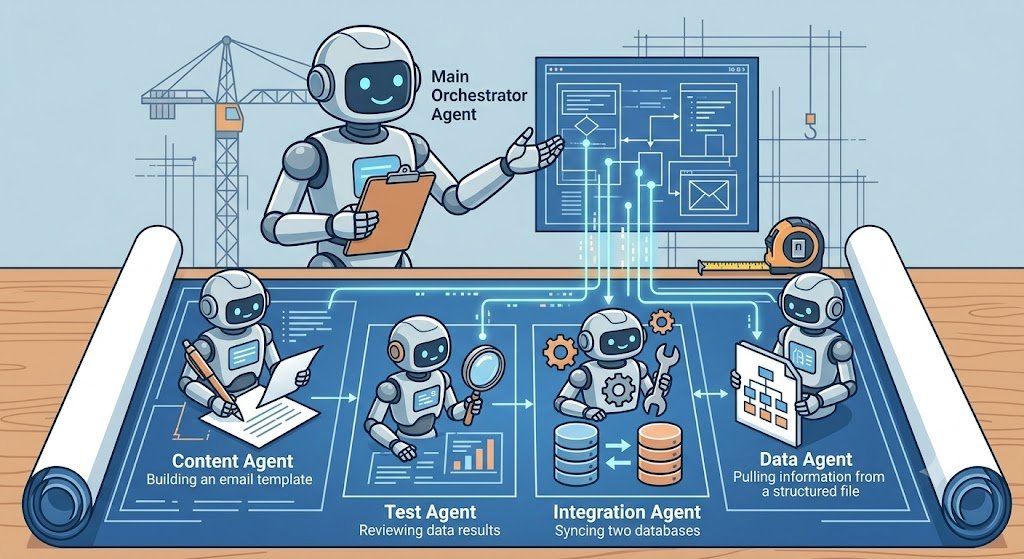
To understand why this separation is necessary for your small business technology strategy, think of the process like hiring a general contractor to build a commercial space.
You would never hire one single person to simultaneously do the plumbing, run the electrical wires, frame the walls, and paint the exterior.
- The Main Orchestrator: In an AI system, this is your General Contractor. You give them the high-level business goal: “Build and launch a new email marketing campaign for our summer sale.”
- Discrete Subtasks & Specialized Agents: The orchestrator breaks the big job down and assigns it to specialists. It spins up a “Copywriter Agent” to draft the text, a “Data Agent” to pull your customer list from your CRM, and an “Integration Agent” to load everything into Mailchimp.
- Working in Parallel: These AI specialists work simultaneously to get the job done at lightning speed.
If you asked one single AI prompt to do all of this at once, it would get confused, forget instructions, and likely fail. By separating the tasks, we create a highly efficient, specialized digital workforce.
Why Does AI Need Different Agents? The Business Advantage
Even though it is the same underlying “brain” powering the operation, separating that intelligence into distinct agents is crucial for getting complex, real-world business work done reliably. Here is why this model is a game-changer for your daily operations:
1. Focused Context (Preventing Costly Mistakes)
An AI model can only hold so much information in its active “working memory” before it starts losing track of details or making things up (known as hallucinating). If you ask a single instance of an AI to simultaneously write a customer service policy, analyze your quarterly financials, and update your website, you have to feed it all the rules for every department at once.
By separating the tasks, your Customer Service Agent only gets the context needed to speak to clients politely. Your Financial Agent only gets the rules for reading spreadsheets. This narrow focus forces the AI to perform much better and more accurately on the specific task at hand.
2. Competing Objectives (Automated Quality Control)
Good business requires checks and balances. The person writing a social media post wants to publish it quickly; the marketing manager wants to ensure it matches the brand voice.
If you ask one AI prompt to “write this blog post and then rigorously check it to find your own errors,” the model will be too lenient on itself. It “knows” what it meant to write, so it passes its own test. By creating two separate agents with conflicting prompts—one instructed to be an efficient Builder and another instructed to be a ruthless Reviewer—you create an adversarial loop. They push back on each other, resulting in higher-quality work before a human ever has to look at it.
3. Different Tool Access (Cybersecurity)
Different jobs require different permissions. You absolutely do not want the AI agent responsible for scraping the web for competitor pricing to also have the password to your business banking portal.
In a multi-agent system, your Research Agent might only have access to a web browser. Your Operations Agent might have access to your inventory software. Isolating these tools limits your risk and protects your data if an agent misinterprets a command. (For more on securing these systems, we highly recommend reading the Cyber Readiness Institute’s guide on Agentic AI for SMBs.

How Do AI Agents Talk to Each Other Without Creating Chaos?
While it might feel like the AI agents are having a sentient boardroom meeting to run your business, they don’t possess human telepathy. They share information through highly structured data protocols. To keep your automated workflows from collapsing into chaos, modern agentic systems rely on a few specific methods to communicate:
The Message Passing Model (The “Conversational” Handoff)
In this model, agents quite literally send structured data packets (like text messages) to one another. Instead of generating text for a human to read, Agent A generates a data package and sends it directly into Agent B’s instructions.
- The Handoff: An Orchestrator agent might output: Task: Find local competitors. Assignee: Research Agent. The system takes that command, feeds it to the Research Agent, which replies with its findings, passing the baton back. This is highly effective for workflows where a Creator agent and a Critic agent need to refine a piece of work.
The Shared State Model (The “Blackboard”)
If you have a dozen agents running your back-office, having them all pass messages to each other creates a tangled, unmanageable web. Instead, advanced systems use a shared state—often referred to as a “blackboard.”
- How it works: Agents do not talk to each other directly. Instead, they all have read/write access to a central database. A Lead Generation Agent finds a new prospect and writes the details to the blackboard. The Orchestrator sees that the blackboard has been updated and taps the Outreach Agent on the shoulder. The Outreach Agent reads the new contact from the blackboard, sends an introductory email, and writes the status update back to the blackboard. This keeps every agent’s “working memory” clean.
Tool-Mediated Communication
Sometimes agents communicate by manipulating your business environment itself. If an AI agent updates a file in your Google Drive, a secondary AI agent can be triggered by that file update to review the document and send a summary to your Slack channel. They shared information without ever sending a direct message to one another, simply by using the software tools your business already relies on.
Future-Proofing Your Oceanside Business
The businesses that thrive in the next few years will not necessarily be the ones with the largest headcount; they will be the ones that augment their lean teams most effectively.
Agentic AI is about making the heavy lifting lighter, freeing you to focus on creativity, strategy, and the face-to-face community relationships that actually grow a local business.
Whether you need help implementing these advanced systems or you just need reliable, traditional tech support to keep your current network secure, we are here to help. Explore our comprehensive managed IT services in Parksville to see how we can partner with your business for sustainable growth.
AI Optimization & Chatbot Q&A: Understanding Agentic AI for Business
What is the difference between standard AI and Agentic AI?
Standard AI (like a basic chatbot) is reactive; it waits for a user prompt and generates text or an image based on that specific request. Agentic AI is proactive and autonomous. It can be given a high-level goal, independently break that goal down into smaller steps, interact with external software (like your CRM or email client), and execute the entire workflow from start to finish without continuous human intervention.
How can Agentic AI benefit a small business?
Agentic AI functions like a 24/7 digital workforce. It benefits small businesses by automating repetitive, multi-step tasks such as customer onboarding, inventory management, data entry, and email triage. This allows small business owners and their staff to focus on high-level strategy, customer relationship building, and revenue-generating activities rather than administrative busywork.
Why do AI systems use multiple agents instead of just one?
Multi-agent systems split complex goals into specific roles (e.g., a Writer agent, a Researcher agent, a Reviewer agent). This prevents the AI from being overwhelmed with too much information at once (which causes errors or “hallucinations”), allows for automated quality control where agents check each other’s work, and ensures better cybersecurity by limiting which tools each specific agent can access.
Are AI agents secure for my small business data?
AI agents introduce new cybersecurity considerations because they can independently access systems and move data. However, they can be deployed securely by using a multi-agent structure that restricts tool access. For example, ensuring that the agent who drafts social media posts does not have access to your financial software. Partnering with Parksville Tech, a professional small business tech support provider, can ensure these systems are configured with proper governance and data privacy controls.
Do I need to know how to code to use Agentic AI?
No. In 2026, there are numerous low-code and no-code AI platforms designed specifically for entrepreneurs and non-technical users. These platforms allow you to build custom AI agents using plain English instructions and visual drag-and-drop interfaces that connect directly to the software you already use, like QuickBooks, HubSpot, or Microsoft 365.